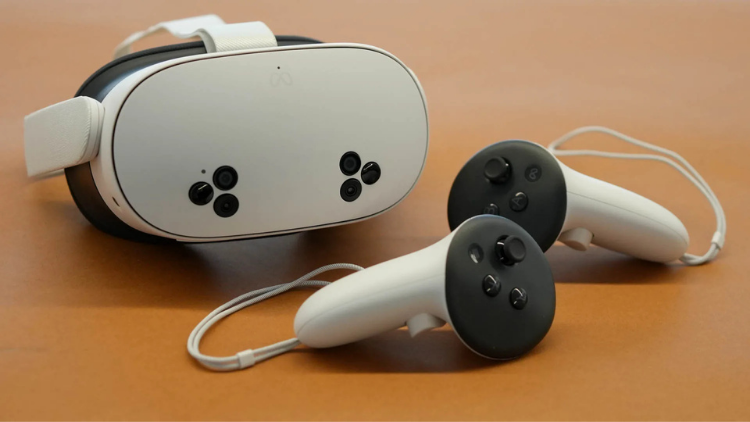
The virtual reality landscape changed dramatically when Meta released their Quest 3S 128GB in October 2024. This standalone headset represents a significant shift in the market—offering premium processing power at a more accessible price point. With the same Snapdragon XR2 Gen 2 chipset as its more expensive sibling, the Quest 3S brings mixed reality capabilities to a wider audience without requiring connection to a PC or console.
According to early adoption statistics, the 128GB model has quickly become Meta’s fastest-selling VR headset, particularly among first-time VR users seeking quality without breaking the bank. The question remains: does this more affordable option deliver a compelling experience, or are the compromises too significant?
Technical Specifications and Hardware Overview
Processor and Performance
The Meta Quest 3S packs surprising power with its Qualcomm Snapdragon XR2 Gen 2 chipset—the identical processor found in the more expensive Quest 3. This strategic decision ensures the budget-friendly headset doesn’t compromise on raw computing capability, allowing it to run the same applications and games as its premium counterpart, albeit with some visual concessions.
The processor delivers consistent frame rates and responsive performance across most applications in the Quest ecosystem, establishing a solid technical foundation that belies the headset’s entry-level positioning.
Display Quality
Each eye is treated to a 1,832 × 1,920 pixel display, delivering crisp visuals that strike a balance between fidelity and performance requirements. The panels support refresh rates up to 120Hz, enabling smooth motion in compatible applications and reducing the likelihood of motion sickness during rapid movements.
While not class-leading in resolution, the displays provide sufficient pixel density for clear text rendering and detailed environments in most applications and games.
Storage and Memory
The base model ships with 128GB of internal storage paired with 8GB of RAM. This configuration supports approximately 30-40 games depending on their size, though larger titles like The Walking Dead: Saints & Sinners can consume significant space. For users with extensive libraries, a 256GB variant is available at a higher price point.
The 8GB RAM allocation handles multitasking efficiently, allowing quick switching between applications without noticeable loading delays.
Optics
One of the more significant trade-offs comes in the form of Fresnel lenses rather than the pancake lenses found in the Quest 3. These older-style lenses contribute to a slightly narrower field of view and can introduce more prominent “god rays” (light artifacts) in high-contrast scenes.
The practical impact is most noticeable in dark environments with bright elements, where light scattering becomes more apparent compared to premium models.
Weight and Comfort
The Quest 3S weighs approximately 514 grams (1.13 lbs), which places it in the midrange for standalone VR headsets. The weight distribution is well-balanced, preventing excessive front-heaviness that can cause discomfort during extended sessions.
The standard fabric head strap provides adequate support for sessions of moderate length, though many users may eventually consider upgrading to an elite strap for improved weight distribution during longer play sessions.
Connectivity
The headset features Wi-Fi 6E support, ensuring robust wireless connections for multiplayer gaming, content downloads, and streaming applications. This future-proofed connectivity standard minimizes latency and maximizes bandwidth, critical factors for smooth virtual reality experiences.
Bluetooth connectivity enables pairing with external audio devices, though the built-in spatial audio solution provides convincing directional sound for most applications.
Battery Performance
With approximately 2.5 hours of typical usage between charges, the Quest 3S offers sufficient battery life for standard gaming sessions. However, more demanding applications can deplete the battery more quickly, with some users reporting closer to 2 hours of actual play time with graphically intensive games.
The included charging cable allows for play while charging, though this limits mobility and may introduce heat management considerations during extended use.
Mixed Reality Capabilities and Passthrough
Color Passthrough Technology
The Quest 3S features full-color camera passthrough, enabling mixed reality experiences that blend virtual elements with your physical environment. The passthrough quality, while not photorealistic, provides sufficient clarity to interact with your surroundings without removing the headset.
This technology fundamentally changes how the device can be used, allowing for seamless transitions between virtual and augmented reality applications.
Environmental Understanding
Room mapping capabilities enable the headset to recognize and remember your physical spaces, allowing for persistent placement of virtual objects. This spatial understanding forms the foundation for mixed reality applications that can transform living rooms into interactive playgrounds or workspaces.
The system accurately identifies floors, walls, and larger objects, though smaller items may not always register in the spatial map.
Boundary System
Meta’s Guardian system allows users to define safe play areas, triggering visual warnings when approaching physical boundaries. This critical safety feature helps prevent collisions with walls or furniture during immersive experiences.
The boundary creation process is straightforward, requiring a simple tracing of available space, and the system reliably maintains awareness of these boundaries during gameplay.
AR Applications
A growing library of applications leverage the mixed reality capabilities of the Quest 3S, from productivity tools that place virtual screens around your workspace to games that transform your living room into fantastical landscapes.
While still developing, this ecosystem demonstrates the potential for mixed reality to become a central feature rather than a mere novelty.
Tracking Accuracy
The headset employs inside-out tracking without requiring external sensors or base stations. Four outward-facing cameras track both the environment and the controllers with impressive precision, maintaining accurate positioning even during rapid movements.
This self-contained tracking solution contributes to the plug-and-play simplicity that makes the Quest 3S accessible to VR newcomers.
Hand Tracking
Controller-free interaction capabilities allow for natural hand gestures in supported applications. While not as precise as controller inputs for gaming, the hand tracking technology works well for menu navigation and casual experiences.
This feature shines in social applications where natural gestures enhance communication and in productivity tools where controller use might be cumbersome.
The Verdict: Is the Quest 3S 128GB Right for You?
The Meta Quest 3S 128GB strikes an impressive balance between affordability and capability. For newcomers to VR or casual users, the compromises in optics and field of view are easily outweighed by the significant cost savings and powerful performance. The same processor as premium models ensures games run smoothly, while the mixed reality features open up exciting possibilities beyond pure VR.
However, VR enthusiasts who prioritize visual clarity and immersion might find the Fresnel lenses and slightly narrower field of view limiting. For those users, saving for the premium Quest 3 might be worthwhile.
Ultimately, the Quest 3S 128GB represents Meta’s most compelling value proposition yet—democratizing access to quality mixed reality experiences without requiring external hardware or technical expertise. For most users entering the VR space in 2025, this headset offers the ideal entry point.
Leave a Reply